
Giving a Glimpse of the Future
By Virginia Noone| Pacific Business News
November 1, 2025
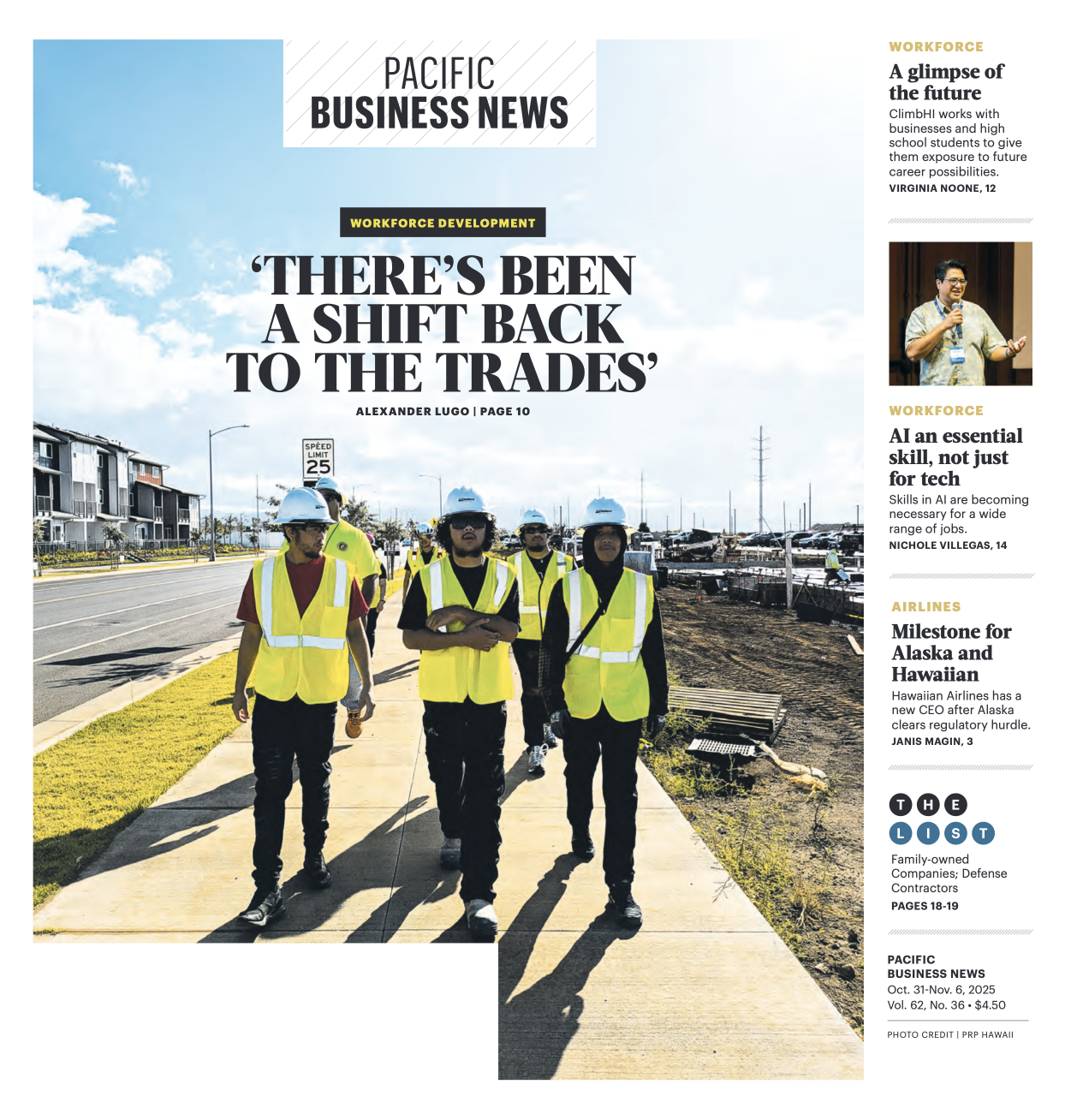

ClimbHI works to combat Hawaii’s “brain drain,” a persistent trend where young residents leave the Islands for college and careers on the Mainland.
With only 53% of Hawaii public high school graduates attending college or other post-secondary education after graduation, ClimbHI wants more high school students to be prepared for jobs and connected to employers who are hiring, according to Morikawa.
“It’s really hard for businesses to get the word out, and it’s really hard for teachers that are wearing so many hats to be able to bring them to the students,” Morikawa said. “And so that’s why ClimbHI and ClimbHI Bridge is so important — because we are really changing that landscape and making it so easy for folks to uncover even simple things that you would think everyone would know.”
Some of the “simple” things that can disqualify young candidates from jobs is not having a driver’s license or a high school diploma. Hawaii’s graduation rate saw its highest rate at 85.8% in 2024, which was only slightly higher than the two previous years, according to a state Department of Education report. The national average was 86.4%, according to U.S. News & World Report data.
ClimbHI focuses on growing Hawaii’s workforce by working with more than 560 businesses, 200 schools, and 5,000 educators through various programming.
One challenge to building the future workforce is younger workers unaware of local opportunities. ClimbHI works to bridge that gap.
Connecting online and through exposure
Through ClimbHI Bridge — an online portal that connects educators, businesses, and students — future job candidates can understand these simple requirements by communicating with companies sooner.
ClimbHI launched ClimbHI Bridge in December 2020 in partnership with the Hawaii DOE and funding from the Hawaii Executive Collaborative, and has engaged more than 300,000 students.
“We’re all about evolving, adapting, and supporting our youth in their journey to success. That means we’re constantly seeking efficient and effective solutions for career development,” Morikawa said. “One of the innovative concepts we’ve introduced is something we call ‘exposureships.’”
Through these exposures, companies can show high schoolers how their businesses function and what job opportunities there are in the field. The exposureships require less commitment from students and employers than traditional internships, making it more accessible for both. The program’s goal is to just allow students to dip their toes into the job for a brief time.
Alaska Airlines took part in this, inviting eight students to come onto the tarmac and other areas of the airport to learn about different jobs, according to ClimbHI.
Retaining young talent in Hawaii
“We’ve seen that those that are leaving had no idea that there were so many opportunities [in Hawaii],” Morikawa said. “Whenever we’re running events, it’s like half of the people believe they cannot be economically self-sufficient.”
Morikawa conducts surveys before and after events to track the perception participants have of the job market and their ability to be self-sufficient. She said typically, by the end of an event, 90% believe they can stay in Hawaii for work and be economically self-sufficient, marginally higher than when asked at the beginning.
She also finds through surveying that a lot of students discover career interests outside of their pre-established “pathway.” Many of these careers do not require a post-secondary degree, and interested candidates can begin developing the technical skills needed while still in high school, while often working with Hawaii companies, Morikawa said.
“Once you’ve seen something you truly want, you’ll do everything in your power to achieve it. That’s the kind of focus and drive we aim to inspire in our youth — whether they choose to stay in Hawaii or leave and eventually return,” Morikawa said. “We want them to understand that while opportunities exist everywhere, Hawaii needs them to help move our state forward.”
ClimbHI said it has completed 2,578 events over five years, engaging 399,000 students with businesses donating $730,000 in business hours. Morikawa said every industry faces worker shortages, and setting students up for success by providing early exposure to job requirements and opportunities is crucial to filling these gaps.
“I see [workforce development] from a unique perspective, working closely with the next generation — so many of whom are eager to discover their dreams, pursue their passions, and start building their futures right now,” Morikawa said.
For more, visit climbhi.org.